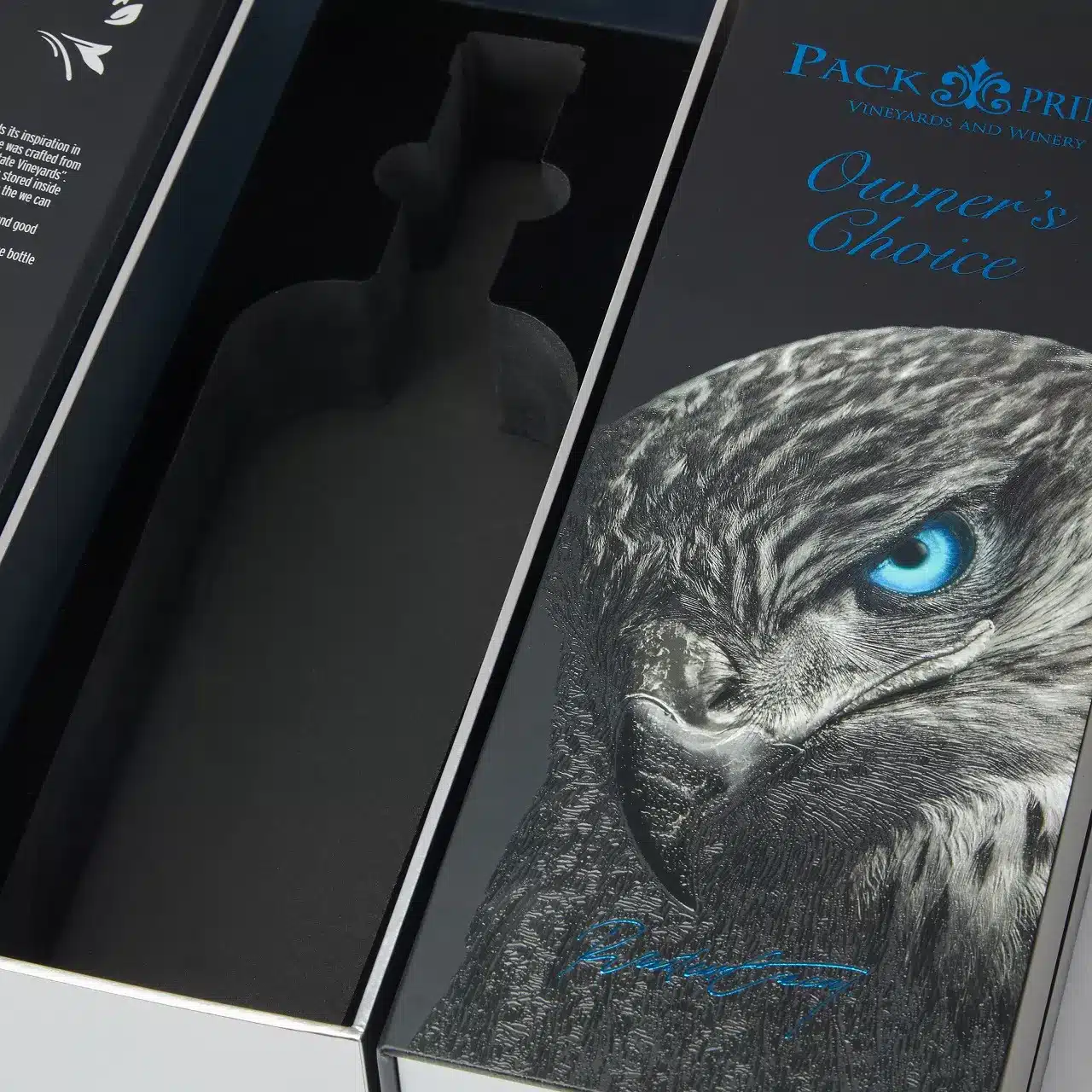
Wine Packaging, within the luxury market, is not a secondary consideration — it is a brand statement delivered before the first sip. The tactile experience of a rigid gift box, the depth of its surface finish, and the longevity of its visual appeal are all measurable dimensions of perceived product value.
A technical breakdown of how Scodix digital UV, warm-temperature foil stamping, and polymer embossing outperform traditional finishing methods across every dimension that matters in premium rigid box manufacturing.
In the luxury wine market, packaging is not a secondary consideration — it is a brand statement delivered before the first sip. The tactile experience of a rigid gift box, the depth of its surface finish, and the longevity of its visual appeal are all measurable dimensions of perceived product value.
Traditional printing and finishing techniques — UV coating, hot stamping, cold foiling, and mechanical embossing — have long formed the backbone of high-end packaging production. Each of these processes has been refined over decades and, under the right conditions, can produce results that meet premium market expectations.
However, as luxury packaging standards have continued to rise globally, the structural limitations of these conventional methods have become increasingly difficult to reconcile with the demands of top-tier wine brands. Inconsistent gloss levels, oxidation-related foil degradation, and the mechanical constraints of die-based embossing all introduce quality variables that compound at scale.
“True luxury packaging is defined not by how it looks on launch day, but by how it holds up twelve months later in a collector’s cellar.”
Scodix digital enhancement technology was engineered specifically to address these gaps. By integrating digital UV inkjet printing, a proprietary low-temperature foiling process, and UV-polymerized 3D embossing into a single coherent system, Scodix delivers a level of finishing precision and durability that traditional analogue methods cannot reliably replicate.
This article provides a technical comparison across all three core processes — examining the underlying mechanisms, measurable performance differences, and specific production advantages relevant to luxury wine packaging.
The Structural Limits of Traditional Finishing Methods
Before evaluating Scodix technology, it is useful to understand precisely why conventional finishing methods fall short in premium packaging contexts — not as a general critique, but as a technical analysis of specific mechanisms and failure modes.
Screen-printed UV coating
Screen UV is a plate-based process in which liquid UV varnish is pushed through a mesh screen onto the substrate. The mesh introduces a fundamental precision ceiling: the varnish deposit is relatively uniform in thickness across the printed area, gradients and variable-density effects are impossible to achieve, and fine detail reproduction is limited by plate-making tolerances. The resulting gloss typically measures between 60 and 70 GU (gloss units) — adequate for standard commercial packaging, but noticeably flat against the benchmarks set by current luxury brands. Additionally, traditional UV varnish formulations are susceptible to oxidation over time, resulting in yellowing and a progressive loss of optical clarity.
Conventional hot stamping
Hot stamping applies metallic foil to a substrate using a heated die, with process temperatures typically exceeding 100°C. This high heat introduces immediate structural and optical vulnerabilities.
First, the aluminum metallization layer within the foil is thermally degraded during transfer. This degradation compromises the true specular reflection that is essential for a premium metallic finish.
Second, the combination of heat and pressure applied over the natural grain of the paper creates micro-level surface irregularities. These irregularities cause the foil to reflect light diffusely—a flaw clearly exposed under raking light on any mass-produced box.
Finally, long-term stability remains a critical risk. Within six to twelve months of production, conventional hot-stamped foil frequently exhibits edge lifting, delamination, or blackening due to oxidation.
Mechanical embossing
In traditional embossing, a male and female die set compresses the substrate from both sides, causing the paper fibers to permanently deform and create a raised surface relief. The physical deformation necessarily creates a corresponding depression on the reverse face of the sheet. For luxury rigid box construction — where the printed sheet is laminated to a greyboard substrate — this reverse depression must be filled and smoothed before lamination, introducing additional process steps that increase cost and reduce manufacturing yield. Furthermore, paper-fiber embossing is inherently susceptible to environmental conditions: changes in temperature and humidity cause the compressed fibers to relax over time, gradually flattening the relief and reducing tactile definition.
Scodix Digital UV vs. Screen UV Coating
Scodix replaces the plate-based screen UV process with piezoelectric inkjet deposition of proprietary resin-based UV inks. Each droplet is placed digitally, with full independent control over volume, density, and position. This shift from analogue to digital deposition unlocks capabilities that are simply not achievable within the constraints of a screen-printed process.
| Dimension | Traditional Screen UV | Scodix Digital UV | Practical Significance |
|---|---|---|---|
| Gloss level | 60–70 GU | Up to 99 GU | Achieves a water-drop, crystal-clear optical surface |
| Long-term clarity | Prone to yellowing and oxidation | Fade-resistant resin ink | Maintains visual quality across multi-year product lifecycles |
| Pattern precision | Limited by plate-making tolerances | Variable density & gradient control | Replicates organic textures — leaf veins, silk, stone grain — with photographic accuracy |
| Relief height | Flat to minimal relief | Up to 250 microns | Braille mode achieves extreme raised heights in a single production pass |
| Texture variety | Uniform gloss only | Gloss, matte, velvet, tactile grain | Multiple surface effects achievable within the same printed layer |
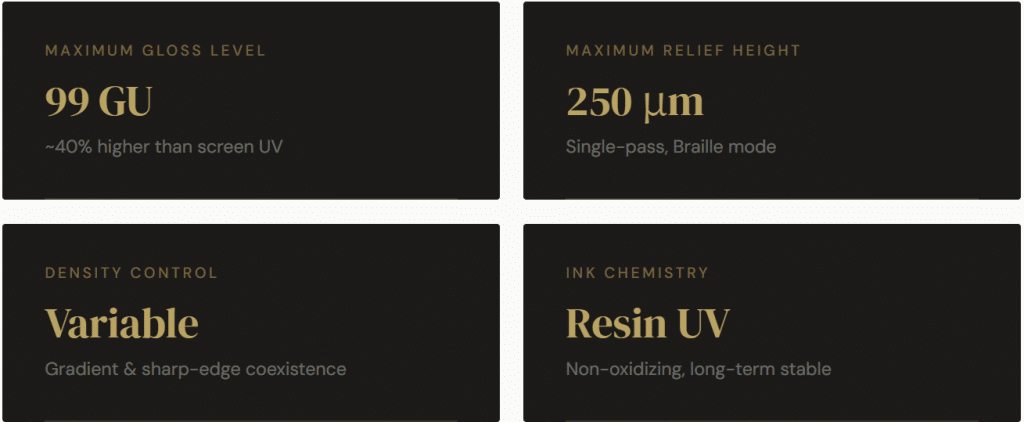
The gradient density capability is particularly significant for wine packaging applications, where organic motifs — botanical illustrations, vineyard topography, heritage crests — require smooth tonal transitions that screen UV cannot reproduce. Scodix can modulate ink deposition volume pixel by pixel, creating seamless gradients between fully raised, high-gloss elements and flat matte backgrounds within a single print run, with no additional tooling or process steps.
Scodix Warm-Temperature Foiling vs. Hot Stamping
Scodix approaches the foiling problem from a fundamentally different direction. Rather than transferring foil through high-temperature die pressure, Scodix uses a digitally deposited adhesive layer — applied precisely to the desired foil areas — and effects transfer at a tightly controlled temperature range of 30–40°C. This process is referred to as warm-temperature foiling, and it eliminates the root causes of quality degradation in both conventional hot and cold stamping.
Traditional Hot Stamping
- Process temperature exceeds 100°C
- Thermal oxidation degrades metallization
- Foil reflects diffusely over paper grain
- Edge lifting risk within 6–12 months
- No gradient or variable-area capability
Scodix Warm Foiling
- Controlled 30–40°C throughout transfer
- Zero thermal degradation to metallization
- Resin pre-fill creates optically flat substrate
- Long-term adhesion, no blackening or lifting
- Digitally controlled foil placement area
The optical mechanism behind the mirror finish
The key to understanding Scodix foil quality lies in what happens before the foil is applied. Prior to foil transfer, Scodix deposits its resin ink over the target area, filling the microscopic surface topography of the paper stock. The cured resin creates an optically smooth, level base — effectively eliminating the paper grain entirely from the optical equation. When the metallic foil is subsequently transferred onto this pre-leveled surface at low temperature, it adheres to a substrate that is flat at the microscopic scale.
The result is a foil surface that reflects incident light as a single coherent wavefront — the physical definition of a specular mirror finish. Conventional hot stamping, applied directly to textured paper without this preparation step, scatters light from thousands of micro-surface irregularities and produces the characteristic diffuse sheen that falls noticeably short of true mirror reflectivity.
Digital adhesive deposition
Scodix UV resin is inkjet-deposited precisely onto foil-target areas and cured, creating an optically flat bonding surface that simultaneously fills paper grain.
Low-temperature transfer at 30–40°C
Foil is pressed onto the adhesive layer at temperatures that activate bonding without triggering oxidation reactions in the metallization layer.
UV cure and adhesion lock
Final UV curing forms a permanent cross-linked bond between foil, adhesive, and substrate — a chemical lock that prevents delamination, edge lifting, and long-term oxidation blackening.
Scodix Polymer Embossing vs. Mechanical Die Embossing
The distinction between Scodix polymer embossing and conventional die embossing is not merely a matter of degree — it represents a fundamentally different structural approach to creating three-dimensional surface relief.
Where mechanical embossing deforms the substrate itself, Scodix builds the relief entirely above the substrate surface using accumulated UV resin. The substrate is never compressed, stretched, or mechanically altered. The three-dimensional form is purely additive.
Core Technical Distinction
Mechanical embossing is a subtractive-deformation process: material is displaced downward to create upward relief, inevitably producing a reverse depression. Scodix embossing is an additive-deposition process: UV resin is built up in layers above the original substrate surface, leaving the reverse face entirely undisturbed.
Manufacturing yield implications
For rigid box manufacturing — specifically the construction of double-door presentation boxes and traditional clamshell wine cases — the absence of a reverse-face depression is a significant production advantage. In conventional embossed packaging, the lamination step requires an intermediate filling and leveling process to smooth the back of the printed sheet before it can be cleanly bonded to the greyboard. This step adds labor, increases material usage, and introduces a quality control variable that affects yield rates. Scodix polymer embossing eliminates this step entirely: the sheet can proceed directly to lamination with no back-face preparation.
Dimensional stability under environmental stress
Scodix embossed reliefs are composed of UV-cured polymer rather than deformed cellulose fibers. Once cured, the polymer network is cross-linked and dimensionally stable — it does not absorb or release moisture, and it does not undergo the creep and relaxation behavior that characterizes mechanically embossed paper over time. In accelerated aging tests, Scodix embossed surfaces maintain their original relief height and edge sharpness across wide temperature and humidity cycles, while mechanically embossed equivalents show measurable relief reduction under the same conditions.
For wine packaging specifically — which is frequently stored in cellars and temperature-controlled environments with fluctuating humidity — this long-term dimensional stability is a meaningful quality differentiator.
Applications Across Premium Wine Packaging Structures
Scodix technology is applicable across the full spectrum of premium wine packaging formats. The following summarizes the most impactful use cases for each structural type.
Double-door presentation boxes
The exterior panels of double-door boxes benefit most from the combination of Scodix digital UV (for high-gloss label reproduction and tactile organic textures) with warm-temperature foil stamping on crests and brand wordmarks. The absence of reverse-face depression in the embossed elements simplifies lid panel lamination and improves structural flatness.
Classic rigid clamshell cases
Single-bottle and multi-bottle clamshell cases frequently feature full-coverage surface treatments where consistent gloss across large print areas is critical. Scodix digital UV delivers uniform 99 GU gloss with no screen-joint artifacts, while the variable-density capability supports complex illustrative designs common in fine wine branding.
Collector edition and limited release packaging
For limited editions where tactile differentiation justifies higher per-unit cost, the combination of Scodix warm foiling and 250-micron polymer embossing creates a surface complexity — mirror metallic elements alongside architectural 3D relief — that positions the package clearly at the apex of the luxury segment.
Summary: The Case for Scodix in Luxury Wine Packaging
The competitive advantage of Scodix technology over traditional finishing methods is not the result of any single process improvement. It derives from the systematic resolution of three distinct failure modes — gloss ceiling and long-term yellowing in UV coating, thermal degradation and diffuse reflectivity in hot stamping, and reverse-face deformation and environmental instability in mechanical embossing — within a single integrated digital production system.
For packaging buyers and brand managers operating in the premium wine segment, the practical implications are straightforward. Scodix delivers measurably higher initial visual quality, substantially improved long-term finish durability, and meaningful reductions in lamination complexity for rigid box structures. In markets where packaging is a direct proxy for product value — and where a decline in finish quality after months on a retail shelf reflects directly on brand perception — these advantages are not marginal.
The technology has achieved broad adoption and high maturity in European and North American luxury markets, across fine wine, spirits, fragrance, and jewelry categories. It is fully compatible with standard rigid box construction formats, including double-door presentation cases, traditional clamshell structures, and slipcase configurations.
Scodix Technology, Production-Ready
Our manufacturing facility has fully integrated Scodix finishing into our premium packaging production lines. We produce double-door presentation boxes, classic rigid cases, and custom wine packaging structures with complete Scodix digital UV, warm foiling, and polymer embossing capability — at production scale.