A practical, EEAT-driven guide for packaging importers who want clarity on shipping responsibilities, cost control, and risk allocation.
📑 Quick Navigation
- What Does “Incoterms Explained” Really Mean?
- Why Packaging Buyers Must Understand Incoterms
- EXW Explained – Lowest Cost, Highest Risk
- FOB Shenzhen Explained – The Industry Standard
- DDP Explained – Convenience with Hidden Costs
- EXW vs FOB vs DDP Comparison
- Common Mistakes First-Time Importers Make
- Why Choosing the Right Supplier Matters
- Final Recommendations for Packaging Imports
What Does “Incoterms Explained” Really Mean?
In international trade, Incoterms define how responsibilities, risks, and costs are divided between buyers and sellers. These standardized rules determine who handles shipping, customs clearance, insurance, and delivery.
According to multiple logistics guides, the key principle is simple: Incoterms allocate cost, risk, and operational responsibility across the supply chain.
For packaging imports—especially from China—misunderstanding these terms often leads to unexpected freight costs, delays, or compliance issues.
Why Packaging Buyers Must Understand Incoterms
First-time buyers sourcing packaging (such as custom boxes, rigid packaging, or printed cartons) frequently underestimate logistics complexity.
Industry sources highlight that incorrect Incoterm selection can result in:
- Hidden logistics costs
- Unclear liability during transit
- Unexpected import duties and delays
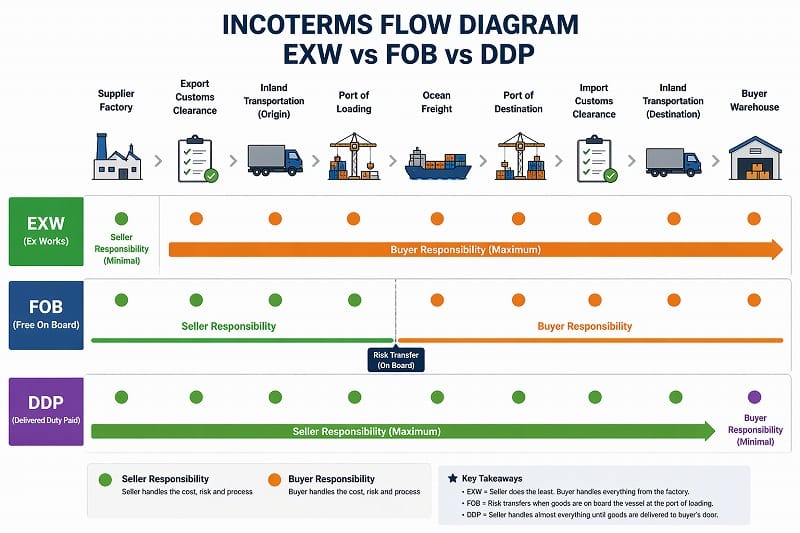
For example, under EXW, buyers assume nearly all responsibilities from the factory onward, while under DDP, sellers manage almost everything including duties and delivery.
EXW Explained – Lowest Cost, Highest Risk
EXW (Ex Works) means the supplier only prepares goods at their facility. From that point, the buyer handles everything—pickup, export clearance, freight, and import procedures.
Key characteristics:
- Seller responsibility: minimal
- Buyer responsibility: maximum
- Best for: experienced importers with logistics partners
Research consistently shows that EXW shifts nearly all cost and risk to the buyer, making it operationally demanding.
For packaging imports, this often leads to underestimated costs—especially in inland trucking and export handling.
FOB Shenzhen Explained – The Industry Standard
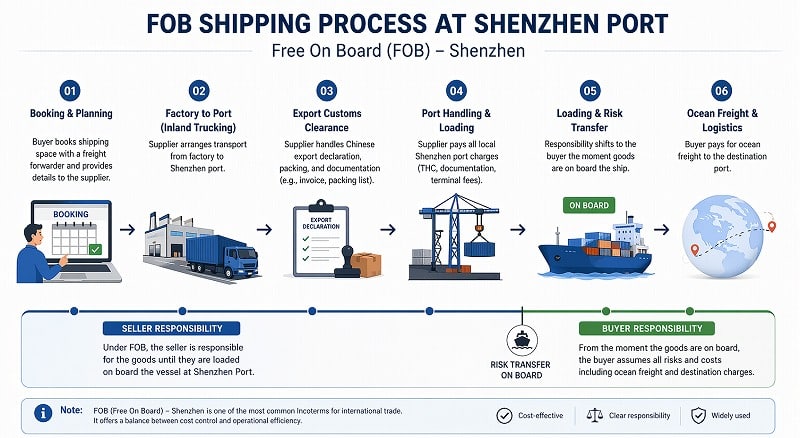
FOB (Free On Board – Shenzhen) is the most commonly recommended Incoterm for packaging buyers sourcing from China.
Under FOB:
- The supplier delivers goods to the port (e.g., Shenzhen)
- The supplier handles export clearance and loading
- Risk transfers once goods are onboard the vessel
This creates a balanced structure—suppliers manage origin logistics, while buyers control international freight.
Experts widely consider FOB a “middle-ground” option, offering both cost efficiency and manageable risk.
For example, when working with a professional packaging manufacturer like DHP Factory, FOB Shenzhen is typically the most efficient setup. It ensures proper export handling while allowing buyers to optimize shipping costs through their own freight forwarders.
DDP Explained – Convenience with Hidden Costs
DDP (Delivered Duty Paid) is the most buyer-friendly option on paper. The supplier manages transportation, customs, duties, and final delivery.
Key features:
- Seller handles almost everything
- Buyer simply receives goods
- Higher overall cost
However, studies indicate that while DDP reduces operational burden, it can mask embedded costs and reduce transparency.
For packaging imports, DDP is often used by beginners or eCommerce brands seeking simplicity.
EXW vs FOB vs DDP Comparison
| Criteria | EXW | FOB Shenzhen | DDP |
|---|---|---|---|
| Cost Control | High | Medium | Low |
| Risk Level | High | Moderate | Low |
| Best For | Experts | Most importers | Beginners |
Common Mistakes First-Time Importers Make
- Choosing EXW to save money but underestimating logistics complexity
- Assuming DDP includes all hidden fees
- Not specifying port clearly (e.g., “FOB Shenzhen”)
- Ignoring risk transfer points
Experts emphasize that risk and cost do not always transfer at the same moment—one of the most common misconceptions in global trade.
Why Choosing the Right Supplier Matters
Incoterms alone do not guarantee a smooth import process. Supplier capability is equally critical.
A professional packaging manufacturer should:
- Offer flexible Incoterm options (EXW, FOB, DDP)
- Provide export documentation support
- Have experience with international logistics
At DHP Factory, we specialize in custom packaging solutions with FOB Shenzhen as the default shipping model—ensuring both efficiency and cost transparency for global buyers.
👉 Explore our capabilities: Custom Packaging Solutions
Final Recommendations for Packaging Imports
For most first-time buyers:
- Choose FOB Shenzhen for balanced cost and control
- Use DDP only when simplicity outweighs cost concerns
- Avoid EXW unless you have a reliable logistics network
Ultimately, understanding Incoterms explained is not just about definitions—it is about making informed sourcing decisions that directly impact your margins, timelines, and customer satisfaction.